
Designing for Preservation: How Architecture and Restoration Technology Respond to Modern Conflict
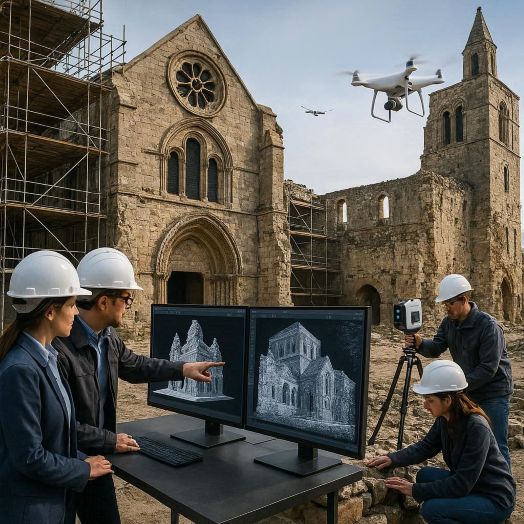
Armed conflicts have damaged or destroyed thousands of culturally significant buildings over the past decade, placing irreplaceable architectural heritage at risk. Historic monuments, religious sites, museums, and traditional neighborhoods often become unintended casualties of war. As these losses grow, architects, engineers, and conservation experts are combining traditional restoration practices with advanced digital technologies to preserve history for future generations.
Modern architectural conservation increasingly relies on digital documentation before physical restoration begins. Research from UNESCO shows that high-resolution laser scanning, drone surveys, photogrammetry, and three-dimensional modeling allow specialists to capture accurate records of damaged structures, even when access remains limited. These digital archives provide detailed measurements, structural information, and visual references that guide reconstruction efforts long after conflicts have ended.
The Challenge of Protecting Cultural Heritage
Historic buildings often carry deep cultural, religious, and historical value. Their destruction affects more than architecture because it can weaken community identity and erase evidence of centuries of craftsmanship. Reports from UNESCO have documented extensive damage to heritage sites in countries including Ukraine, Syria, and Iraq, demonstrating how modern conflicts continue to threaten globally recognized landmarks.
Physical restoration becomes especially difficult when original construction records have disappeared or building materials are no longer available. Safety concerns, unexploded ordnance, and unstable structures further complicate efforts, making accurate documentation essential before reconstruction can safely begin.
Digital Technology Creates New Opportunities
Digital preservation tools have transformed the way restoration projects are planned. Laser scanners create millions of precise measurement points within minutes, while drones safely capture aerial imagery of damaged roofs, towers, and inaccessible areas. Photogrammetry software combines hundreds of photographs into detailed three-dimensional models that engineers can examine from anywhere in the world.
Studies published by ICOMOS, the International Council on Monuments and Sites, explain that these digital records improve restoration accuracy and reduce uncertainty during rebuilding. Engineers can compare damaged structures with archived models to identify missing architectural elements, evaluate structural movement, and estimate repair priorities.
International Collaboration Strengthens Recovery
Successful preservation depends on cooperation across many disciplines. Architects, archaeologists, structural engineers, historians, surveyors, and local craftspeople each contribute specialized knowledge. Findings from ICCROM, the International Centre for the Study of the Preservation and Restoration of Cultural Property, emphasize that involving local communities helps protect traditional construction techniques alongside physical buildings.
International partnerships have expanded rapidly in recent years. Digital archives created through projects led by organizations such as CyArk provide detailed three-dimensional records of important heritage sites before disasters occur. These datasets become valuable resources when restoration planning begins after damage.
Technology Supports Long-Term Preservation
Restoration extends beyond rebuilding damaged walls. Building Information Modeling, artificial intelligence, and structural monitoring systems now help conservation teams evaluate long-term stability after repairs are completed. Experts note that continuous monitoring can identify new structural movement, moisture problems, or environmental damage before serious deterioration develops.
Digital replicas also serve educational purposes. Museums, universities, and researchers can create virtual exhibitions that allow people to explore endangered heritage sites even when travel remains impossible. This broader public access encourages awareness while preserving valuable historical information.
Looking Ahead
Modern preservation combines centuries of architectural knowledge with rapidly evolving digital technology. Although armed conflict continues to threaten cultural landmarks around the world, better documentation, stronger international cooperation, and advanced modeling tools provide practical ways to reduce permanent losses. Continued investment by organizations such as UNESCO, ICOMOS, and ICCROM will help ensure that future generations can understand, restore, and appreciate the architectural heritage that defines human history.