
What Urban Exhibition Spaces Can Teach Designers About Scale, Texture, and Audience Attention
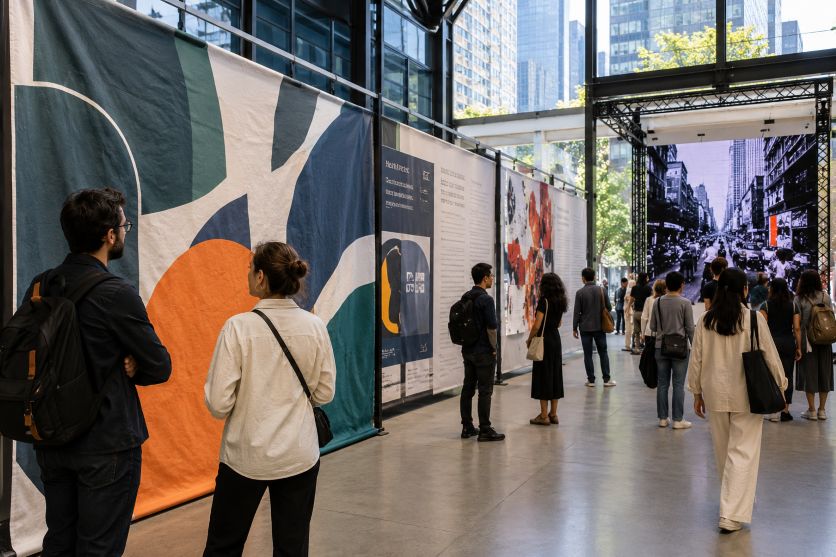
The American Alliance of Museums has noted that visitor experiences are shaped by layout, visual communication, and how people move through a space. Large public environments rarely operate like controlled digital screens. People walk, pause briefly, shift directions, and divide their attention across many competing elements. These realities make urban exhibition spaces useful environments for understanding how visual design functions in everyday situations.
Discussions around public display systems often include examples from large-format applications and printed visual materials. Resources connected with step and repeat printing NYC illustrate how designers think beyond digital screens and begin adapting artwork for larger physical settings. Once a design enters a public environment, visual decisions start interacting with distance, lighting conditions, material surfaces, and audience movement.
Designers spend much of their time creating work on laptops and monitors where dimensions remain fixed and predictable. Colors appear illuminated from behind a screen, details remain sharp at close range, and viewers usually control their distance from the image. Despite the importance of digital design tools, public environments create different conditions. A poster hanging in an exhibition hall or a visual installation placed in a city setting introduces variables that cannot be ignored.
Why Screen-Based Assumptions Can Create Problems
Many visual elements that look effective on a computer screen lose strength once transferred into larger spaces. Small typography may become difficult to read. Fine details can disappear from a distance. Color differences that seem obvious on a monitor can appear less noticeable under changing lighting conditions.
Research from the Society for Experiential Graphic Design shows that environmental graphics depend heavily on viewing conditions and audience behavior. People moving through public environments rarely stand in ideal positions. They glance at visuals while walking, speaking with others, or navigating surrounding spaces.
This creates a practical challenge. Designers may assume that enlarging artwork automatically solves visibility issues. In reality, scale changes how visual information behaves.
Imagine an exhibition panel designed on a 15-inch laptop screen. The same layout enlarged to several feet wide can reveal spacing problems, inconsistent image quality, or areas where text feels crowded. What once appeared balanced can suddenly feel overwhelming.
Understanding Scale Beyond Size
Scale involves more than making objects bigger. It changes how people experience visual information.
Experts from Nielsen Norman Group note that people scan visual information quickly and tend to focus first on dominant elements before processing smaller details. Similar patterns appear in physical environments where visitors often spend only a few seconds looking at displays.
Because of this, designers frequently create visual hierarchies. Main messages appear first. Supporting information follows later. Secondary details remain available without competing for attention.
Large exhibition environments often provide clear examples of this principle. Strong imagery usually captures attention immediately. Supporting graphics and text then provide additional context.
These choices become especially important in busy urban environments where visual competition exists everywhere.
Competing for Attention in Public Spaces
Cities contain countless visual signals. Building signs, traffic systems, storefront displays, lighting, and moving crowds all compete for attention simultaneously.
Data published by the International Sign Association suggests that environmental signage and display systems work best when information remains clear and easily recognized. Human attention has limits, particularly in environments with constant movement.
This means that design success often depends on reduction rather than addition.
Adding more graphics, more text, or more visual effects does not automatically create stronger communication. Sometimes clarity emerges through restraint.
Urban exhibition spaces repeatedly demonstrate this idea. The displays that attract attention often rely on strong contrasts, simple messaging, and deliberate spacing rather than excessive detail.
How Materials Change the Design Experience
Digital design exists largely on flat illuminated surfaces. Physical environments introduce another layer, material behavior.
Surface texture changes how light interacts with graphics. Some materials absorb light while others reflect it. Fabrics move slightly with air flow. Matte finishes reduce glare. Glossy surfaces can increase brightness but may create reflections under strong lighting.
The Interaction Design Foundation notes that human perception responds to texture and environmental cues alongside visual information. Physical materials therefore become part of the communication process rather than simple delivery tools.
Large textile displays, printed backdrops, and event graphics often reveal these differences clearly. A large fabric display may soften colors compared with digital screens. Surface texture can affect how images appear from different viewing angles.
These observations explain why designers frequently test materials before final production. The same design may produce different visual experiences depending on where and how it appears.
Audience Behavior Shapes Design Decisions
Designers sometimes focus heavily on visuals while assuming audiences will naturally stop and engage with them. Public environments rarely work that way.
Museum studies published by the Smithsonian Institution indicate that visitor movement patterns strongly affect engagement levels. People tend to follow natural traffic paths, pause at visual focal points, and spend limited time with individual displays.
These patterns influence many design decisions.
- Viewing distance affects text size.
- Walking speed influences information density.
- Lighting conditions affect color choices.
- Movement patterns shape placement decisions.
Audience attention therefore becomes part of the design process itself.
Large-format display systems, branded photo backdrops, textile exhibition graphics, and visual installations all demonstrate how design shifts once people become active participants rather than stationary viewers.
Designing for Spaces Rather Than Screens
Urban exhibition spaces continue offering lessons that extend beyond galleries and events. They show that successful design depends on context, human behavior, and environmental conditions.
Scale changes perception. Texture influences experience. Attention depends on movement and surroundings.
Large visual displays and environmental graphic systems remind designers that ideas do not stay frozen once they leave a screen. They enter spaces filled with motion, light, and human interaction. Understanding those conditions helps transform visual concepts into experiences people can actually notice, understand, and remember.
Design, therefore, becomes less about creating isolated images and more about creating communication that works in the places where people live and move.